A long waitlist looks like proof that families love your program. It can also be a compliance exposure, and it is worth looking at it that way.
Before you add seats, find out why the list exists. The fix for a staffing problem will not solve a room problem.
This post is for you if
- One or more of your ELO-P sites has a waitlist
- You are unsure what the law requires when a parent asks for a seat
- You have considered bringing in outside help and want to know whether it would work
01 / What the law says about access
Under California Education Code §46120(b)(2), LEAs funded at the higher tiers, including those at 55 percent unduplicated pupils or above, “shall provide access to any pupil whose parent or guardian requests their placement in a program.” Under §46120(b)(3), other LEAs must provide access to any unduplicated pupil whose parent or guardian requests placement.
The statute defines “provide access” in §46120(g)(6) as to enroll in the program. It adds that a pupil with a signed registration form on file “shall be considered enrolled.”
The financial exposure is in §46120(c)(2). If an LEA fails to offer or provide access to eligible pupils, the state withholds an amount “proportionate to the number of pupils” affected.
We are not lawyers, and how a particular waitlist is treated will depend on your facts and on current CDE guidance. Still, if you have eligible students waiting, your legal and business offices should know about it. Check the CDE ELO-P FAQ and ask your auditor how waitlists are viewed.
02 / Pull the real numbers
Build one table, by site and grade band:
- Students enrolled and students attending
- Students waiting, and how long they have waited
- Whether those waiting are unduplicated pupils
- Staff budgeted, staff actually in place and open positions
- Rooms available and rooms actually used
Often the most useful number is the gap between enrolled and attending. If 120 students are enrolled and 85 come on a typical day, your waitlist may be partly a registration problem.
03 / Find the cause and match the fix
| Cause | How you can tell | What helps | What does not |
|---|---|---|---|
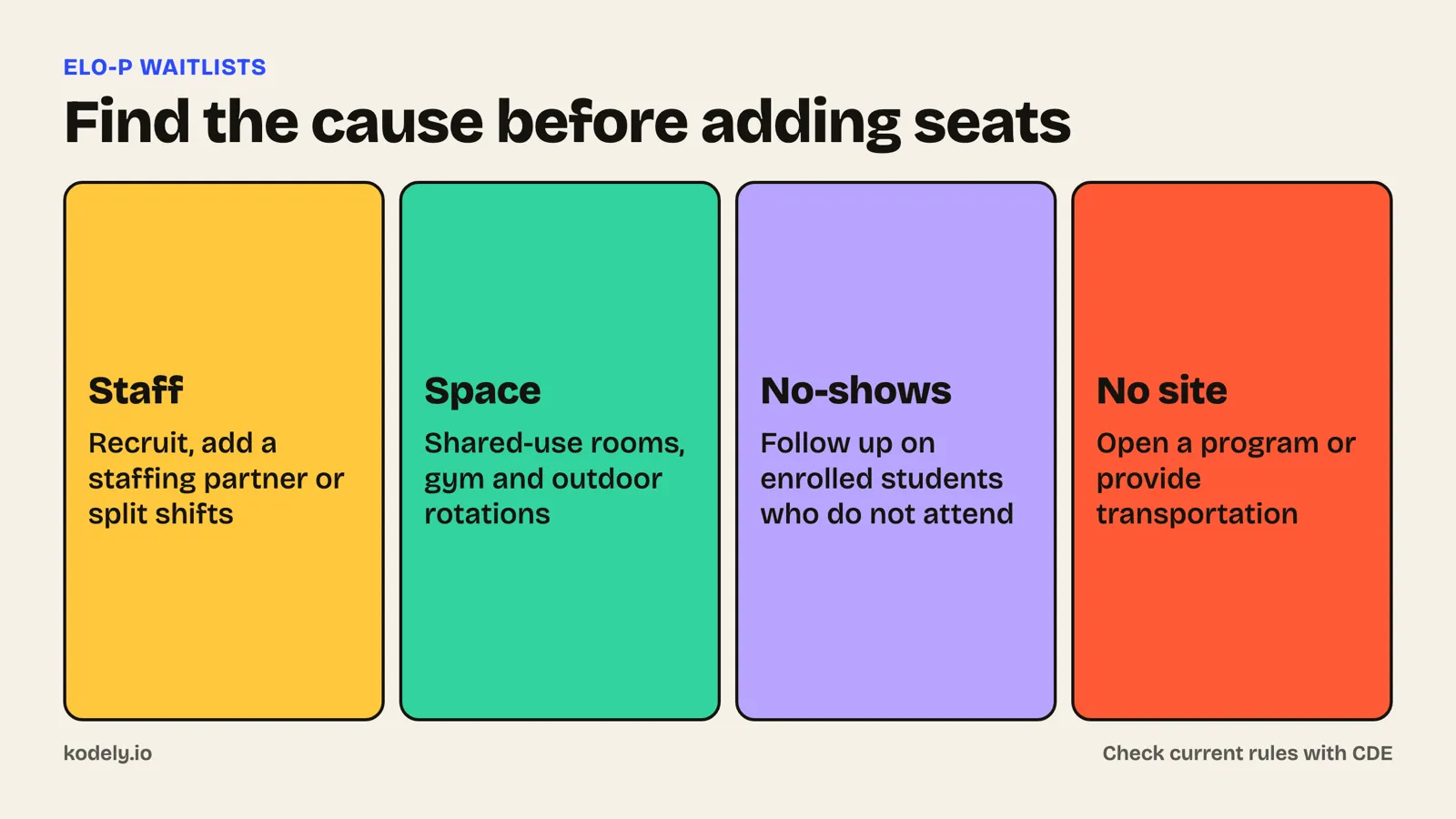
| Not enough staff | Open positions, ratios maxed out | Recruiting, staffing partner, split shifts | More curriculum |
| Not enough space | Staff available, no rooms | Shared-use agreements, gym and outdoor rotations | More staff alone |
| Enrolled but absent | Attendance well below enrollment | Attendance follow-up and clear enrollment rules | Adding seats |
| School has no program | Families at that school cannot get in | Open a site or provide transportation | Waiting |
| Grade band full | TK and K waiting while older groups have room | Move staff to meet 10:1 | Adding to older groups |
04 / Staffing is usually the first thing to check
When a site is full, it is often full because of ratios. Each additional group of 20 needs another adult, and each additional 10 in TK or kindergarten does too, under §46120(b)(5)(D) and §8483.4.
If you have rooms but no people, adding staff opens seats directly. Be careful with one common mistake: a specialty class that comes once a week does not add a permanent seat unless it also adds supervised capacity for that group. An outside partner helps a waitlist only if it brings adults who count toward your ratio.
05 / When the answer is another site
Under §46120(g)(6), an LEA receiving ELO-P funds must provide transportation for any pupil who attends a school that is not operating a program to a location that is, and back to their original location or another location the LEA establishes. So if a school has no program, students there are not simply out of luck.
Section 46120(b)(6) also directs LEAs to prioritize sites in the lowest-income communities, while maximizing the number of schools and neighborhoods served. Use that language when deciding where to expand first.
06 / Clean up the list
Before asking for more money, do some basic housekeeping:
- Confirm that each family on the list still needs a seat.
- Set a written rule for how long an enrolled student can be absent before a follow-up.
- Offer open seats at nearby sites, along with transportation where required.
- Track how long it takes to place each student.
- Report the number each month, so that the cause stays visible.
Frequently asked questions
Are ELO-P waitlists allowed?
The statute requires LEAs to provide access to eligible pupils whose parents request placement, and it does not describe a waitlist as an exception. Check current CDE guidance and talk to your auditor about your circumstances.
Does a student on a waitlist count as enrolled?
Section 46120(g)(6) says a pupil with a signed registration form on file is considered enrolled. Review how your registration and waitlist forms work in light of that language.
Can ELO-P funds pay for more staff to reduce the waitlist?
Section 46120(d)(3)(A) says funds shall be used to support pupil access to programs, including through hiring certain staff. Check specific costs against your plan and our allowable expenditures checklist.
Will a vendor fix our waitlist?
Only if the problem is one a vendor can solve. A partner can add people. It cannot add rooms, and it will not fix an enrollment list that is out of date.
Have a waitlist you need to shrink?
If staffing is what is holding you back, Kodely can place cleared after-school staff or run additional capacity at your sites. Send us your numbers by site, and we will tell you whether we can actually help.
Give us 20 minutes. On a call. That is it. Book a time here.
Sources and further reading
- California Education Code §46120
- California Education Code §8483.4
- CDE Expanded Learning Opportunities Program FAQ
Published by The Kodely Blog. This post is general information and not legal advice. Confirm current requirements with CDE, your auditor and your counsel.