The most common thing parents say when they hear about game design class: “Oh, so they just play video games all day?”
The second most common: “I’m not sure I want my kid spending more time on screens.”
Both reactions are understandable. And both are wrong. Here’s what actually happens in a well-designed game design class — and why the skills transfer far beyond the screen.
First: What Game Design Class Is Not
Game design class is not free gaming time with an educational label on it. The distinction matters: playing a game is consuming. Designing a game is creating. A student playing a game is reacting. A student designing a game is deciding, building, testing, failing, revising, and deciding again. These are completely different brain activities.
What Kids Actually Do in Game Design Class
Weeks 1-2: Game Design Documents
Before touching any software, students answer questions professional game designers wrestle with: What is the goal? Who is the player? What’s the core loop — the action the player repeats? Students produce a written spec for their game. This teaches structured thinking, persuasive writing, and — critically — scoping. Most first-time designers want to build a game with 47 levels and a multiplayer mode. Learning to say “let’s build one level first and make it great” is one of the most valuable lessons in any creative discipline.
Weeks 3-5: Building and Debugging
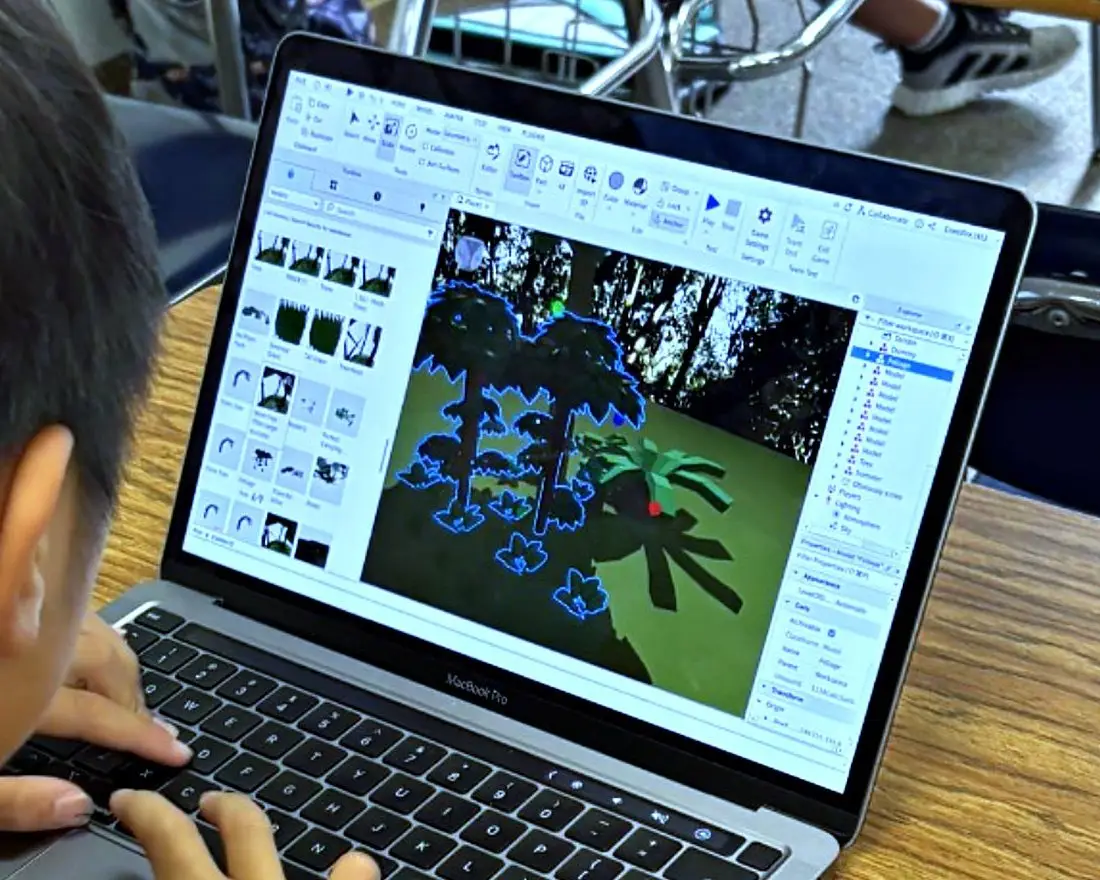
Students use Roblox Studio, MakeCode Arcade, Scratch, or Unity Jr. depending on age. They immediately hit reality: the design document doesn’t match what they can build. The jump mechanic feels wrong. The enemy is too fast. The level is impossible or too easy. This is where the real learning happens — students have to debug not just the code, but the design. Is the problem technical (code is wrong) or experiential (game isn’t fun)? These are different problems requiring different skills.
Weeks 6-7: Playtesting
Students share their games with classmates and watch them play — without explaining anything. This is brutal and revelatory. When a player gets stuck at something the designer thought was obvious, it reveals an assumption they didn’t know they were making. Designing for someone other than yourself is a skill that transfers to product design, writing, teaching, and management. Students take notes, revise, and iterate.
Week 8: Showcase
Students present their finished game to parents, teachers, and classmates — explaining what they built, what changed from the original design, and what they’d do differently. Public presentation, creative confidence, and the ability to articulate a process are skills colleges and employers cite constantly as undertaught.
The Skills, Mapped Explicitly
| What They Do | Skill Built | Where It Shows Up Later |
|---|---|---|
| Writing the design document | Systems thinking, scoping, structured writing | Product management, business, any creative project |
| Writing the first code | Computational thinking, sequencing, logic | Engineering, data analysis, any technical role |
| Debugging when it breaks | Hypothesis testing, persistence, root cause analysis | Engineering, medicine, law, operations |
| Watching someone else play | Empathy, UX thinking, designing for others | Design, marketing, teaching, management |
| Revising after playtesting | Iteration, incorporating feedback | Every creative and collaborative profession |
| Presenting at showcase | Communication, confidence, articulating process | Every professional role that involves people |
What About the Screen Time Problem?
Screen time concerns are legitimate. But the relevant distinction isn’t time-on-screen — it’s active vs. passive use. A child watching YouTube for 2 hours is passively consuming. A child building a game for 2 hours is actively creating, problem-solving, and making decisions. The research on screen time harm focuses almost entirely on passive consumption, not active creation. The American Academy of Pediatrics’ 2023 guidelines explicitly support “creative, interactive, or educational” digital activities rather than blanket time limits.
Who Is Game Design Class For?
The students who benefit most are not always who you’d expect. Yes, kids who love video games are immediately motivated. But the students who often go deepest are the creative kids who haven’t found their medium yet — the storytellers who discover they can build worlds, the artists who discover they can animate characters, the puzzle-solvers who discover they can build puzzles for other people.
Game design is genuinely interdisciplinary: writing, visual design, mathematics, logic, psychology, and storytelling simultaneously. It tends to reach kids who bounce off single-discipline subjects. See also: Game Design Isn’t Just for Future Developers
Kodely runs game design programs using Roblox Studio, MakeCode Arcade, and Scratch at K-8 schools across NYC and California. Summer camp registration is open now.