Prop 28 and ELO-P both put money into California schools, both can fund programs outside the school day, and both get audited. They are not interchangeable. Spending one as if it were the other is a fast way to create a finding.
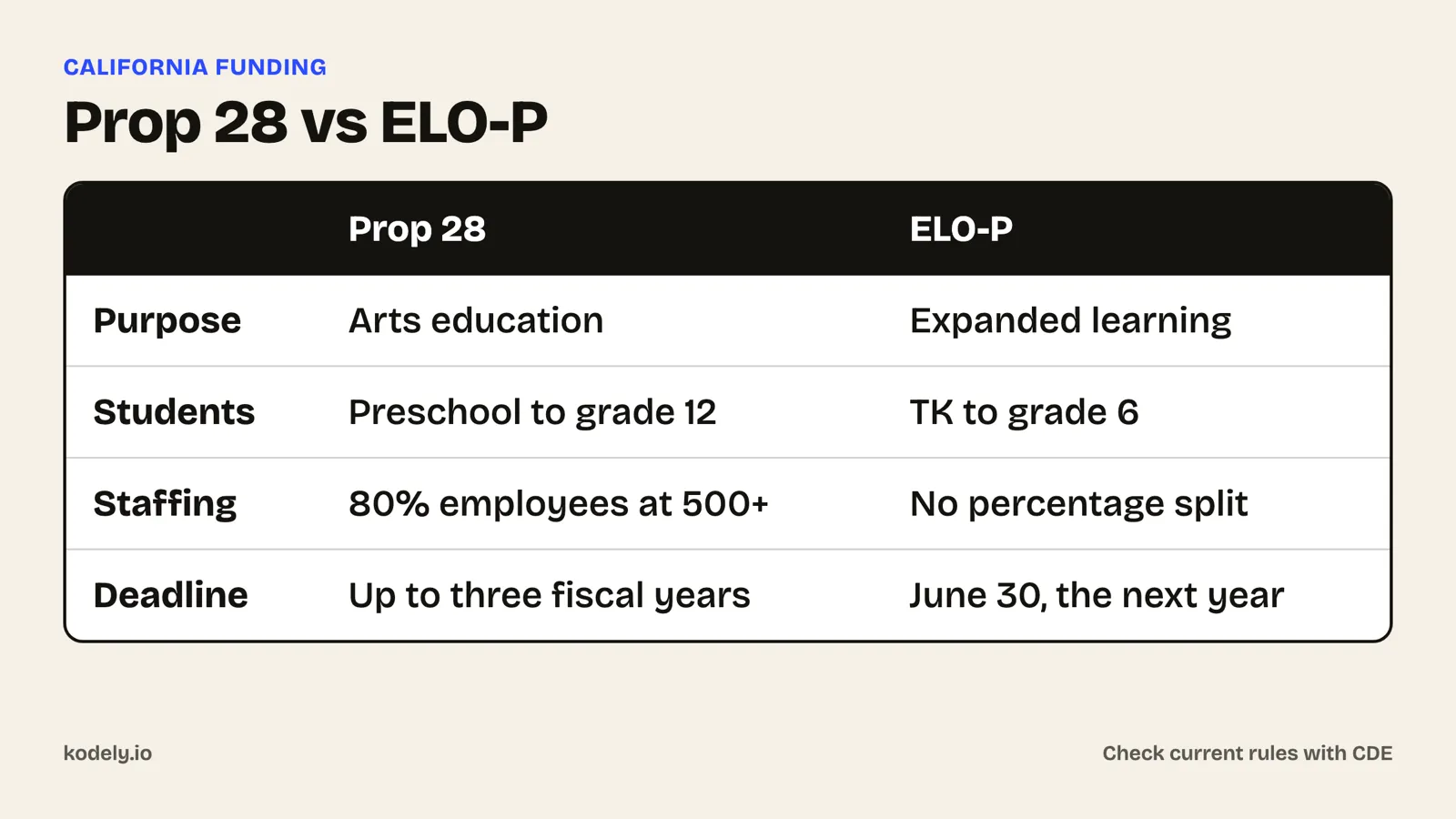
Here is the side-by-side version, including what AB 2440 changes.
This post is for you if
- You manage arts, expanded learning or the budget that pays for them
- You have been asked whether a program can come out of Prop 28 instead
- You want to use both without paying for the same thing twice
01 / The side-by-side
| Prop 28 | ELO-P | |
|---|---|---|
| Law | Ed Code §§8820-8821 | Ed Code §46120 |
| Purpose | Supplement arts education | Expanded learning: enrichment, play, nutrition and more |
| Students | Preschool through grade 12 | Centered on TK through grade 6 |
| Content | Arts education only | Broad, consistent with program rules |
| When | School day or outside it | Before school, after school and non-school days |
| Staffing rule | At least 80% for employees, for LEAs with 500+ pupils | No equivalent percentage split in §46120 |
| Spending window | Up to three fiscal years | By June 30 of the year after appropriation |
| Audit | Yes | Yes |
02 / What Prop 28 can pay for
Prop 28 funds arts education programs. Section 8821(a) names instruction in dance, media arts, music, theatre and visual arts, including areas like photography, graphic arts and design, animation, music composition, script writing, costume design, film and video. It also lists computer coding among creative expressions.
For LEAs with 500 or more pupils, at least 80 percent of funds must go to employing certificated or classified staff to provide arts instruction. The remainder can go to training, supplies and materials, and arts educational partnership programs. Outside partners therefore come out of that smaller share. LEAs under 500 pupils are exempt from the 80 percent rule.
No more than 1 percent can go to administrative expenses, and every dollar must supplement existing arts funding, not replace it. CDE’s FAQ has indicated that Prop 28 programs may take place outside the regular school day. For the audit detail, read Prop 28 supplement-not-supplant.
03 / What ELO-P can pay for
ELO-P is much broader. Section 46120(g)(1) describes opportunities “to engage pupils in enrichment, play, nutrition, and other developmentally appropriate activities,” and (d)(3)(A) says funds support pupil access, including through literacy coaches, tutors, counselors and teachers and aides helping with program enrichment.
It comes with heavier operating requirements: nine-hour days, 30 non-school days, and offer and access duties. Our allowable expenditures checklist covers costs line by line.
04 / Which fund fits which program
These examples use programs in Kodely’s catalog. Always confirm against your own plan.
| Program type | Prop 28 | ELO-P |
|---|---|---|
| Dance, such as a K-Pop troupe | Can fit | Can fit |
| Photography | Can fit | Can fit |
| Stop-motion animation | Can fit | Can fit |
| Puppetry and performance | Can fit as theatre | Can fit |
| Robotics or engineering | No | Can fit |
| Science or Mini Med School | No | Can fit |
| Entrepreneurship | No | Can fit |
| Sports and fitness | No | Can fit |
The Prop 28 test is about the arts. Calling a robotics class “creative” does not make it an arts education program.
05 / Using both together
Three rules keep this clean:
- One cost, one fund. Code each invoice line to a single source.
- Watch the supplant test. Moving an arts class that ELO-P or your general fund already paid for onto Prop 28 raises a supplant question.
- Do not let Prop 28 arts time become your ELO-P compliance plan by accident. Your ELO-P days and hours still have to be met and documented.
See our full guide to braiding ELO-P and Prop 28.
06 / What AB 2440 changes
AB 2440 was signed in September 2026. Check the chaptered text and CDE’s guidance for the effective date and details. The main changes to watch:
- Allowable uses now include curriculum, instructional materials and professional development, aligned to California’s arts standards, framework or preschool and TK foundations
- Pooling across school sites within one LEA, in proportion to each site’s allocation
- A new formula for the supplement-not-supplant baseline
- Per-site certification starting in 2027-28
07 / Deadlines
Prop 28 funds are available for three fiscal years, then unspent money reverts for reallocation. That makes June 30, 2027 the date for 2024-25 funds. ELO-P funds must be spent by June 30 of the fiscal year after the year of appropriation, which makes June 30, 2027 the date for 2025-26 ELO-P funds as well. Two funds, one date, and a good reason to check both balances now.
Frequently asked questions
Can Prop 28 pay for after-school programs?
CDE’s FAQ has indicated yes for programs outside the regular school day, as long as they are arts education programs and meet Prop 28’s other rules. Confirm the current wording.
Can a vendor be paid with Prop 28?
Yes, through arts educational partnership programs. For LEAs with 500 or more pupils, that spending sits within the 20 percent not reserved for employees, unless CDE grants a waiver.
Is STEM eligible under Prop 28?
Prop 28 funds arts education only. STEM programs belong under other sources, such as ELO-P, where allowable.
Which should we spend first?
Start with deadlines and fit. Check which funds expire soonest, then match each program to the fund it clearly qualifies for.
Want a second read on your plan?
Kodely runs arts programs for Prop 28 and expanded learning for ELO-P. Send us what you have planned and we will tell you honestly where each piece fits.
Give us 20 minutes. On a call. That is it. Book a time here.
Sources and further reading
- California Education Code §8820
- California Education Code §8821
- California Education Code §46120
- CDE Prop 28 FAQ
- The Prop 28 Compliance Checklist
Published by The Kodely Blog. This post is general information and not legal advice. Confirm current requirements with CDE and your counsel.