Every ELO-P coordinator knows the number 30. Fewer have a calendar showing exactly where those 30 days fall, who staffs them and what happens if one goes wrong in March.
Here is what counts, what needs a second look, and a simple way to place the days and keep track of them.
This post is for you if
- You are responsible for meeting the ELO-P day requirement at one or more sites
- You have counted summer, but are not sure the total reaches 30
- You are trying to work out whether Saturdays or extended school year days can help
01 / What the statute requires
Education Code §46120(b)(4)(B)(i) requires “at least 30 nonschooldays, inclusive of extended school year days,” with “no fewer than nine hours of in-person expanded learning opportunities per day.”
Three details matter:
- It applies across funding tiers. The day requirement is a condition of receiving funds under §46120(d)(1). It is not limited to districts at a certain unduplicated pupil percentage.
- Nine hours means nine hours of program. On a nonschool day, instruction is not there to fill out the total.
- Frontier programs differ. Programs in frontier designated locations have an eight-hour standard under §46120(b)(4)(C).
The nonschool-day rule is separate from the school-day rule. For the nine-hour school-day calculation, see the 9-hour compliance trap.
02 / What can count
| Type of day | Can it count? | What to check |
|---|---|---|
| Summer weekdays | Yes | Nine in-person program hours each day |
| Winter, spring and fall break | Yes | The days are in your plan and staffed |
| Pupil-free days | Generally yes | It is truly not a school day for students |
| Extended school year days | Yes, with care | Paired hours must reach nine under (b)(4)(B)(ii) |
| Saturdays | With care | See the next section |
| Minimum days | No | These are school days with their own nine-hour test |
03 / The Saturday question
This is where people get tripped up, because two separate ideas share one word.
The statute defines nonschooldays in §46120(g)(4) as days other than regular school days, “inclusive of Saturdays, as described in Section 37223.” So a Saturday is not automatically excluded.
Saturday School is a different matter. A 2023 program comparison circulated in the California expanded learning field says an LEA may run ELO-P on a day when Saturday School is offered, but that Saturday School hours do not count toward the nine ELO-P hours for the 30-day requirement.
The practical reading: if you want a Saturday to count, run nine hours of ELO-P that day, and do not count time students spend in a Saturday School class. Before you build Saturdays into your plan, check the current CDE ELO-P FAQ or ask CDE’s Expanded Learning Division directly.
04 / A way to place the days
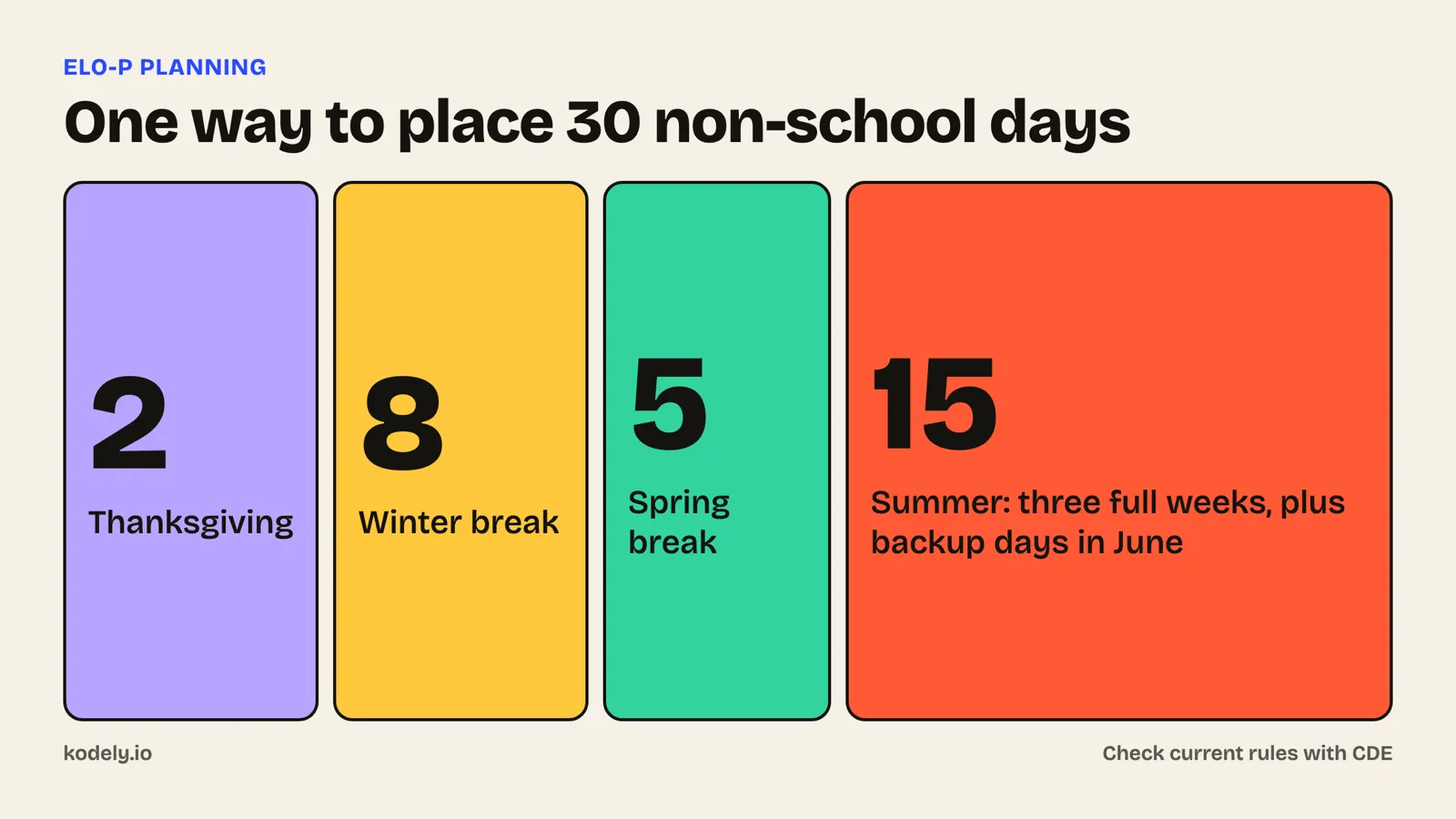
Here is an example only. Your calendar and your community will change the numbers.
| Window | Days | Why it works |
|---|---|---|
| Thanksgiving week | 2 | Short, easy pilot for new sites |
| Winter break | 8 | Working families need coverage |
| Spring break | 5 | One clean themed week |
| Summer | 15 | Three full weeks, easiest to staff |
| Total | 30 |
Work through it in this order:
- Pull your board-approved calendar and mark every non-instructional weekday.
- Remove the days when facilities, custodial services or meals truly cannot be arranged.
- Fill summer first, then add break weeks in the order families most need them.
- Plan 2 or 3 backup days in June, in case a day has to be canceled.
- Assign an owner, a site and a staffing source to each date.
05 / Keep a running count
Set up a single tracker by site with these columns: date, type of day, scheduled hours, actual start and end, students offered, students attending, adults on site and the name of the person who filed the sign-in sheet. Update it the day the program runs, while people still remember.
Why bother? Section 46120(c)(3)(A) sets the district penalty at 0.0048 times the apportionment for each day that fails the day or hour requirements, and charter schools face 0.0049 under (c)(3)(B). On a $2 million apportionment, five short days comes to $48,000. Emergency closures are addressed separately in §46120(b)(12).
06 / How to rebalance in the middle of the year
If winter falls short, do not wait until May. Count the days you have fully delivered, subtract from 30 and move the gap into spring break or the summer. Then get any staffing and facility requests in before summer calendars close.
Frequently asked questions
Does every LEA have to offer 30 nonschool days?
The requirement is tied to receiving ELO-P funds under §46120(d)(1), so it is not limited by UPP level. Who must be offered access does differ. Section 46120(b)(2) and (b)(3) set different offer and access duties depending on the funding tier.
Do students have to attend all 30 days?
No. Section 46120(b)(10) says participation is optional. The requirement is on the LEA to offer and provide the program.
Can the 30 days be split across winter, spring and summer?
Yes, the statute sets a number of nonschool days and does not require them to be consecutive or in one season. Many LEAs spread them across breaks and summer.
Have days you still need to fill?
Kodely runs full-day intersession and summer camps that can cover your required nonschool days, with cleared staff and materials included. If you know how many days you are short, we can tell you quickly whether we can help.
Give us 20 minutes. On a call. That is it. Book a time here.
Sources and further reading
- California Education Code §46120
- California Education Code §37223
- CDE Expanded Learning Opportunities Program FAQ
- ELO-P, ASES and 21st CCLC program matrix, March 2023
Published by The Kodely Blog. This post is general information and not legal advice. Confirm current requirements with CDE and your counsel.