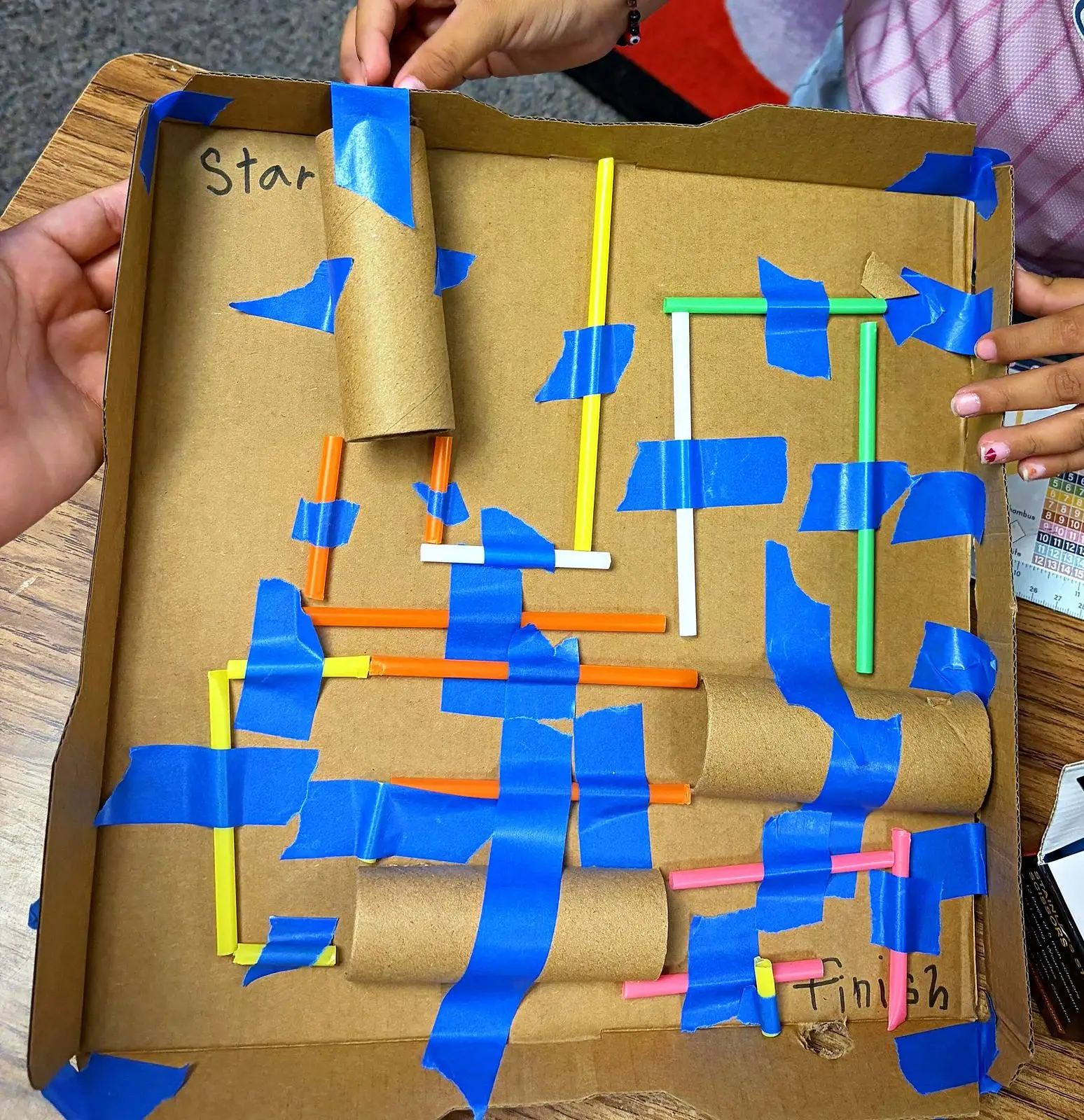
At Kodely, we love sparking curiosity and passion for STEM in middle schoolers with our fun STEM activities for middle school students. Whether you’re a teacher searching for cool classroom projects or a parent wanting to boost your kid’s learning at home, Kodely’s got you covered with an awesome selection of STEM activities. But hey, if you’re on the hunt for even more projects, we’ve rounded up some of our favorites to keep the learning (and fun!) going strong!
Explore the Solar System with a Scale Model
What You Need:
- A large outdoor or indoor space
- Measuring tape or string
- A 5-foot diameter beach ball (representing the Sun)
- Various sizes of balls (to represent planets)
- Smaller pebbles or beads (for moons and smaller planets)
- Signs or labels for each planet
- Optional: Paint or markers to color the planets
Steps:
- Begin by determining the scale of your model. For instance, if the Sun is represented by a 5-foot diameter beach ball, calculate the sizes of the planets accordingly. Overall, this helps students understand the proportional differences between celestial bodies.
- Use your measuring device to map the distances between each planet based on your chosen scale.
- Arrange your planets in the correct order from the Sun.
- Once your model is set up, have the students walk through the solar system. Discuss the unique features of each planet, such as size, composition, and distance from the Sun.
Why It’s Cool: This project turns the abstract concept of the solar system into a tangible and interactive experience. Therefore, by building a scale model, students can better appreciate the size of the planets and the immense distances between them. Above all, it’s a fun way to introduce astronomical concepts and use a bit of math to make sense of our place in the cosmos.
Learning Outcomes: Overall, students will grasp the immense scale of the solar system, understanding the significant size differences and the vast spaces between celestial bodies. Additionally, this activity nurtures spatial reasoning, enhances understanding of astronomical concepts, and demonstrates the application of mathematics in real-world contexts.
Paper Airplane Design Challenge
What You Need:
- Paper (various types and sizes)
- Pennies (for weight)
- Measuring tape or ruler
- A narrow target (such as a hoop or designated landing area)
Steps:
- Set the challenge parameters, such as distance, accuracy, or weight carrying.
- Allow students time to design and build their paper airplanes additionally.
- Test the airplanes under the set conditions and measure their performance.
Why It’s Cool: This activity encourages creativity, problem-solving, and a bit of friendly competition. Additionally, students can experiment with different designs and materials to improve flight performance, learning about aerodynamics and engineering principles in the process.
Learning Outcomes: Enriches students’ STEM education by providing a hands-on understanding of aerodynamics, physics, and engineering principles. In addition, through experimentation with different designs and materials, students develop critical thinking, creativity, and problem-solving skills. They also learn about teamwork and communication as they collaborate and iterate on their designs. For instance, this activity promotes adaptability and resilience as students analyze data, measure performance, and refine their planes, preparing them for more complex STEM challenges.
Make an Alka-Seltzer Powered Lava Lamp
Introduction: Create a mesmerizing and easy science experiment by making DIY lava lamps. For instance, this experiment allows you to make your own alka-seltzer lava lamp and observe how temperature changes affect the behavior of the vibrant blobs.
Materials Needed:
- Tall, clear jars or bottles
- Timer or clock with seconds display
- Water
- Food coloring
- Vegetable oil
- Alka-selzter tablets
Steps:
- Pour water into each jar or bottle until they are about one-quarter full.
- Add a few drops of food coloring to each jar.
- Fill the remaining space in the jars with vegetable oil. Leave some space at the top.
- Break the Alka-Seltzer tablet into smaller pieces, ½ or ⅓ of the tablet additionally.
- Drop a piece of Alka-Seltzer into each jar, screw on the lid, and enjoy!
Why It’s Cool: This lava lamp experiment is fun and engaging – watching the colorful blobs rise and fall as the Alka-Seltzer reacts with water not only captivates the eye but also sparks curiosity about the science behind the phenomenon. Plus, it’s a safe and simple experiment that can be done with common household items, making it accessible and enjoyable for everyone.
Learning Outcomes: Students learn about chemical reactions and the properties of liquids and density. Overall, it’s a great hands-on activity that combines creativity with scientific inquiry, perfect for sparking a love of science in students of all ages.
Paper and Tape Egg Landing Pad
What You Need:
- 10 sheets of paper (per group)
- 1 meter of masking tape (per group)
- Eggs
Steps:
- Distribute the materials to each group.
- Set the challenge to design a structure that can safely cushion an egg additionally.
- Allow time for groups to brainstorm and build their structures.
- Test each structure by dropping an egg onto it from a specific height overall.
Why It’s Cool: This activity is all about innovation and engineering. It teaches students the principles of force and energy absorption. Also, there’s nothing like the thrill of testing your creation and hoping your egg survives the fall!
Learning Outcomes: This engineering challenge teaches students about the principles of force, momentum, and energy absorption. Also, they practice design thinking, creativity, and collaboration. The activity also demonstrates the application of physics in solving practical problems.
Creating a Solar Oven
What You Need:
- Cardboard box
- Aluminum foil
- Plastic wrap
- Black construction paper
- Tape
- Thermometer
Steps:
- Line the inside of the cardboard box with aluminum foil.
- Cover the opening of the box with plastic wrap, creating an airtight seal additionally.
- Place black construction paper at the bottom of the box to absorb heat.
- Position the oven in direct sunlight and monitor the temperature using the thermometer.
Why It’s Cool: This project is a fantastic introduction to sustainable living and environmental science. Overall, it’s incredible to see how effective a homemade solar oven can be, and it’s a tasty way to explore green technology!
Learning Outcomes: Students gain insights into renewable energy sources and the principles of heat transfer. In conclusion, this activity promotes environmental awareness and sustainability.
We hope you like these STEM activities to get middle school students excited about science and technology. These projects aren’t just fun; they’re a gateway to understanding the world through a scientific lens.
Ready to kickstart your STEM adventure? Contact Kodely today to learn more or sign up for a demo of our innovative STEM programs. Above all, let’s inspire the next generation of problem solvers and innovators together!