Summer feels far away in November. It is not. At least one large California district has already posted a February 22, 2027 opening for ELO-P summer registration, which means its dates and sites are effectively settled this winter.
Here is a working timeline, starting now.
This post is for you if
- You plan ELO-P summer days and your calendar is not finished
- You need a vendor approved by your board before summer
- You are counting on summer to reach your 30 non-school days
01 / What a summer day has to be
Summer can carry much of an LEA’s 30 non-school days. Under California Education Code §46120(b)(4)(B)(i), each needs “no fewer than nine hours of in-person expanded learning opportunities.” Extended school year days can count, and on those days, in-person before or after school programming has to bring the combined total to at least nine hours under (b)(4)(B)(ii).
Ratios still apply: no more than 10 to 1 for TK and kindergarten under §46120(b)(5)(D), and §8483.4’s 20 to 1 otherwise.
02 / The timeline
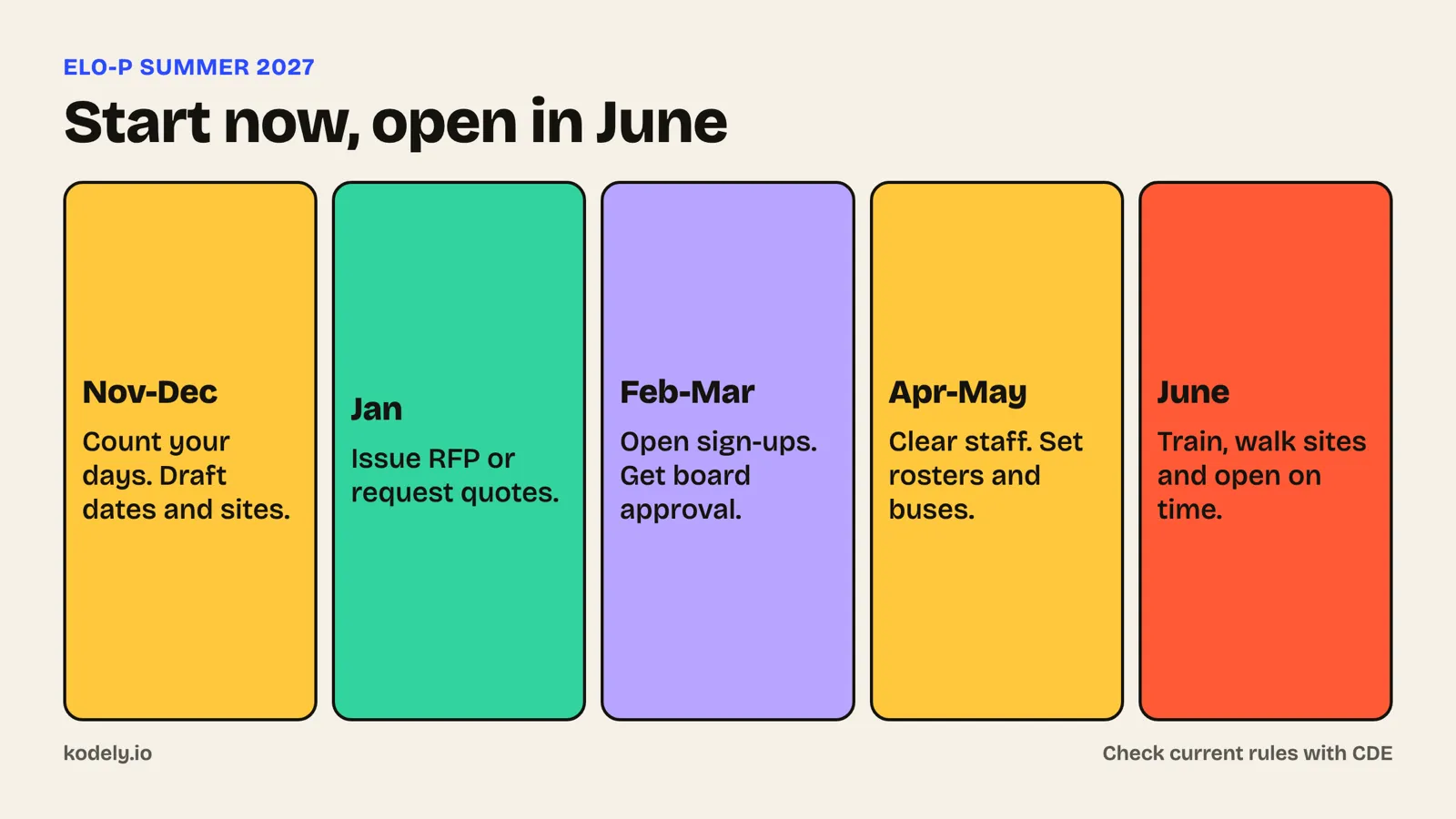
| When | What needs to be done |
|---|---|
| November | Count the non-school days you have delivered and scheduled. Work out what summer must cover. |
| December | Draft dates and sites. Ask facilities about construction and summer cleaning. |
| December | Check your ELO-P balance and spending deadline. Decide on in-house or partner. |
| January | Issue your RFP or request quotes. Coordinate with ESY and summer school leads. |
| February | Select partners. Prepare the board item. Plan family outreach in your site languages. |
| February to March | Open registration. Publish program availability and collect signed forms. |
| March | Board approval. Open staff recruiting and confirm returning staff by name. |
| April | Begin clearances for new staff. Confirm meals and transportation. |
| May | Finalize rosters and staffing at 10:1 and 20:1. Deliver materials to sites. |
| June | Train staff, walk each site and reconfirm headcount. Open on time. |
Your own board calendar and purchasing rules may push these earlier. Work backward from your last board meeting before summer.
03 / The fiscal-year wrinkle
Summer straddles June 30, and that matters in two ways.
Spending. Under §46120(d)(9)(A), funds must be spent by June 30 of the fiscal year following the year of appropriation, and any remainder is returned to the state. For 2025-26 funds, that date is June 30, 2027. Know your balance before you plan summer spending, and ask your business office how June and July costs will be recorded.
Counting days. A June day and a July day fall in different fiscal years. Before you finalize dates, confirm with your auditor or CDE which school year each summer day counts toward, and write it down in your 30-day tracker.
04 / Coordinating with ESY and summer school
ESY and summer school are often planned by different offices, and on the same campuses. Get everyone in one meeting by January, and settle these questions:
- Which sites host which programs, and in which rooms?
- Will students move from ESY into ELO-P the same day?
- Who supervises the transition, and who keeps those records?
- Do the buses match the longer day?
05 / Plan for transportation early
Consolidating to summer hub sites is common. Remember that under §46120(g)(6), an LEA receiving ELO-P funds must provide transportation for any pupil who attends a school not operating a program to a location that is, and back. If you are consolidating, price that in now, because buses are hard to find in May.
06 / Why early registration pays off
Under §46120(g)(6), a pupil with a signed registration form on file is considered enrolled. An early registration window gives you real numbers while you can still hire to meet them. Registering everyone in May leaves you staffing by guesswork.
For ideas on keeping attendance strong, see how to build a summer program students come back to.
Frequently asked questions
When should districts start planning ELO-P summer programs?
The fall before is not too early. If you need a board-approved vendor, new staff clearances or hub-site transportation, start by November or December.
Can summer alone cover the 30 days?
The statute requires at least 30 non-school days and does not say they must be spread out, so summer alone can work if you offer enough nine-hour days. Many LEAs still spread days across breaks to serve families year-round.
Do summer school hours count toward the nine hours?
Be careful here. ELO-P’s nonschool-day standard calls for nine hours of expanded learning. ESY days have their own combined rule under (b)(4)(B)(ii). For other summer school models, check the CDE FAQ and your auditor before counting instructional time.
Need summer covered?
Kodely runs full-day summer and intersession camps with cleared staff and all materials included. The earlier we know your sites and dates, the better we can plan your staffing.
Give us 20 minutes. On a call. That is it. Book a time here.
Sources and further reading
- California Education Code §46120
- California Education Code §8483.4
- CDE Expanded Learning Opportunities Program FAQ
- California ELO-P RFP Template
Published by The Kodely Blog. This post is general information and not legal advice. Confirm current requirements with CDE and your counsel.