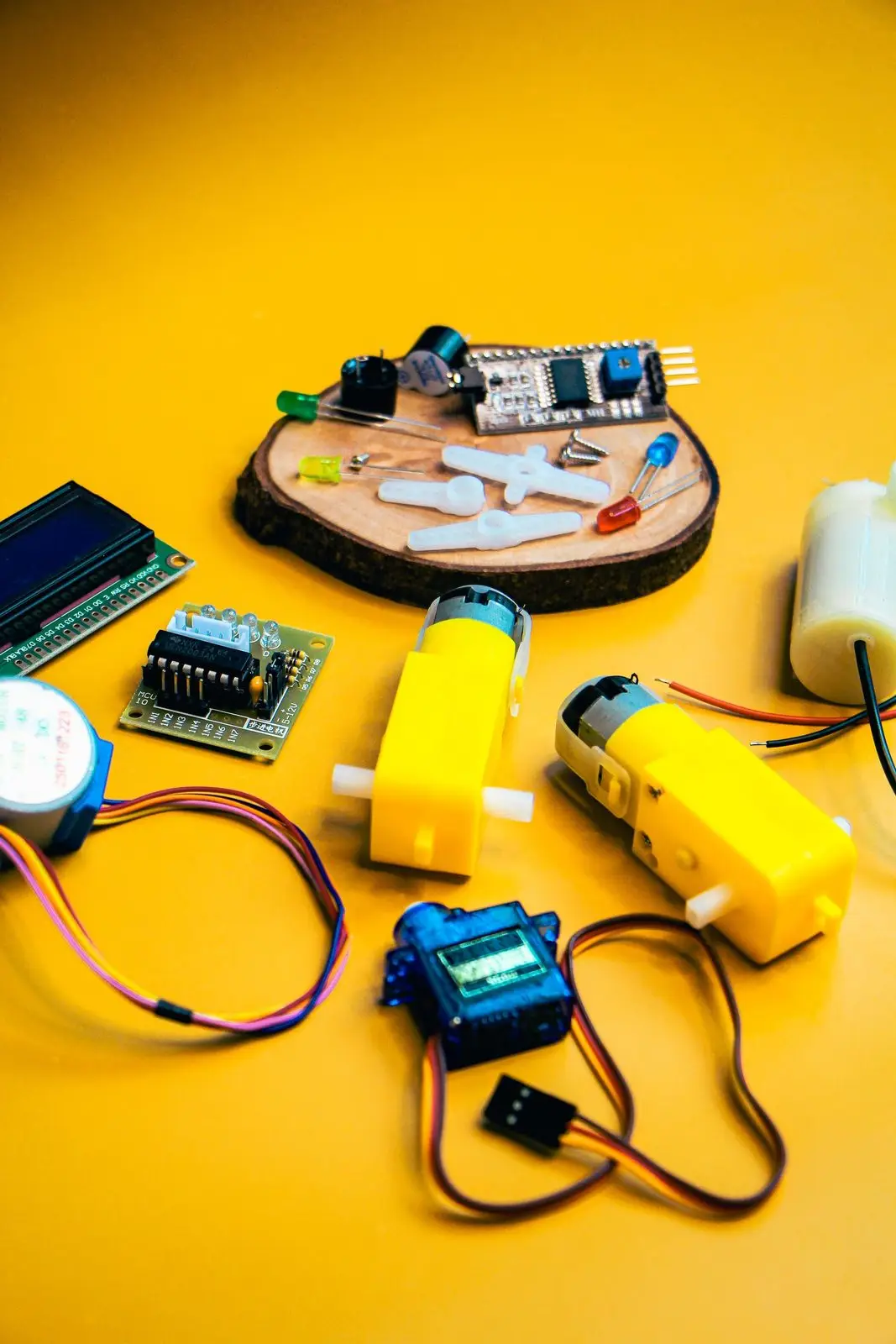
After-school robotics programs for special education students have quietly become one of the more interesting conversations happening in IEP team meetings this year. Not because anyone planned it that way, but because coordinators started noticing things — a student who shuts down during pull-out OT completing a forty-minute build cycle without a single prompt, a child with significant fine motor delays re-threading a gear axle six times until it worked. These observations are informal, anecdotal, and worth taking seriously.
This post is for special education leads, IEP coordinators, and principals who are either already enrolling students with disabilities in robotics enrichment or considering it. The goal is practical: explain what the occupational therapy literature says about why iterative build-and-test environments work, describe what site coordinators are actually observing, and give IEP teams a framework for documenting it.
Why the Build-and-Test Cycle Is Different from Structured Intervention
Pull-out interventions are designed around discrete skill acquisition. A student practices pincer grip with a therapist using standardized materials, earns reinforcement, and repeats. That model has strong evidence behind it for isolated skill development. What it rarely produces is spontaneous generalization — the student using that skill unprompted, in a novel context, under social conditions, when no one is tracking data.
Robotics enrichment works on a different mechanism. The task is open-ended, the feedback is immediate and non-social (the robot either moves or it doesn’t), and the error is visible rather than corrected by an adult. According to occupational therapy literature on motor learning, this kind of task-intrinsic feedback is significantly more effective at building motor planning than therapist-directed correction. Researchers at the University of Southern California’s Division of Occupational Science documented in 2019 that children with developmental coordination disorder showed greater gains in bimanual coordination when engaged in goal-directed construction tasks compared to tabletop fine motor exercises — even when the construction tasks were not designed as therapy.
The robotics environment also has something pull-out time often lacks: genuine stakes. A student who wants their robot to complete the obstacle course has a reason to keep adjusting the wheel placement. That motivation is not manufactured by a token economy. It comes from the task itself.
What IEP Coordinators Are Starting to Document
Site coordinators running Kodely robotics programs have begun reporting behavioral patterns that IEP teams find worth tracking. These fall into three categories that map cleanly onto common IEP goal domains: fine motor planning, frustration tolerance, and task persistence.
Fine Motor Planning
Motor planning — the ability to sequence and execute multi-step physical actions — is a common area of need for students with autism, dyspraxia, and developmental coordination disorder. In robotics, almost every action requires it. Attaching a sensor to a chassis involves orienting the part, aligning the pin holes, applying bilateral pressure, and checking for a secure connection. Students who struggle with handwriting or scissors often find these tasks equally challenging at first.
What coordinators observe over a six-to-eight week session is a shift in approach. Early in a program, students with motor planning challenges tend to use trial-and-error in a disorganized way — trying random orientations, giving up quickly when parts don’t connect. By the midpoint of the program, many begin demonstrating what OT practitioners call “ideation” — pausing before attempting, rotating the part visually, then executing. That cognitive preview step is a hallmark of improved motor planning and is directly observable without standardized assessment tools.
Frustration Tolerance
This is the area where IEP teams are most surprised. Students who have behavioral intervention plans specifically addressing frustration-driven outbursts — throwing materials, eloping, verbal aggression — are frequently completing robotics sessions without those behaviors triggering, even when tasks go wrong multiple times in a row.
The likely explanation sits at the intersection of autonomy and non-social failure. When a therapist or teacher corrects a student, the correction carries a social and evaluative weight. When a robot stops working, the feedback is neutral. The student can attribute the failure to the robot, to the design, to a loose wire — not to themselves. That attribution shift appears to reduce the emotional load of repeated failure enough that students stay regulated longer.
Coordinators can document this concretely: number of self-directed attempts before seeking adult support, time on task before first behavioral indicator, frequency of task abandonment per session. These are observable, repeatable, and defensible for IEP progress notes.
Task Persistence
Persistence is tricky to document in pull-out settings because the task length is controlled by the therapist. In an open enrichment environment, students self-determine how long they engage. IEP teams looking for evidence of improved persistence in naturalistic settings — a common annual goal for students with ADHD and executive function challenges — have a genuine data source in robotics logs.
A student who sustains engagement on a single build challenge for thirty-plus minutes across multiple sessions is demonstrating persistence in a generalized, non-contrived context. That data is more compelling to review committees and re-evaluation teams than therapist notes taken during structured sessions.
A Before/After Framework for Documentation
IEP teams need observable, measurable data. Here is a simple framework drawn from occupational therapy behavioral observation models that site coordinators can realistically implement without formal assessment training.
Baseline (First Two Sessions)
- Time on task before first adult prompt requested
- Number of independent reattempts after a failed build step
- Observable motor planning behavior: does the student preview the action or go immediately to trial-and-error
- Frequency of behavioral indicators associated with frustration (per the student’s BIP if applicable)
Progress Check (Session Six or Seven)
- Same four metrics, collected using the same observation format
- Anecdotal notes on any qualitative shifts: student verbally self-correcting, student helping a peer troubleshoot, student describing a plan before executing
This is not a clinical instrument. It does not replace OT evaluation. What it does is give IEP teams naturalistic behavioral data from a low-pressure, high-motivation context — exactly the kind of generalization evidence that is hardest to collect and most valuable to have.
Practical Considerations for Enrollment Decisions
Not every robotics program is structured the same way. When evaluating whether to include students with IEPs in an after-school robotics enrichment program, administrators should ask a few specific questions about program design.
First, does the program use a build-and-test model or a follow-the-instruction-manual model? The former produces the iterative failure cycles that drive the developmental outcomes described above. The latter is closer to a structured craft activity and is unlikely to produce the same observations.
Second, what is the staff-to-student ratio, and are facilitators trained in behavior-neutral redirection? Students with IEPs in enrichment settings benefit most when facilitators prompt through questions (“What do you think is making it stop?”) rather than corrections (“That piece goes there”). Kodely trains site coordinators specifically on facilitative questioning techniques, which align well with what special education teams are asking for.
Third, is there a mechanism for sharing observations with the IEP team? Even informal session notes, if passed through the special education coordinator, can become part of the student’s record. Some districts have begun including enrichment program coordinators in annual review conversations when the student has been consistently enrolled.
What This Means for Equity-Minded Administrators
One pattern worth naming directly: students with IEPs in Title I schools are disproportionately excluded from enrichment programming, either because of scheduling conflicts with pull-out services, concerns about behavioral fit, or assumptions about what these students can access. The data coming out of robotics enrichment participation suggests those assumptions deserve scrutiny.
Students with motor planning challenges, frustration-driven behavioral profiles, and executive function deficits are not contraindicated for robotics enrichment. In many cases, they appear to be among the students who benefit most from it — precisely because the environment provides something structured intervention rarely does: a real challenge