Most parents who sign their child up for after-school robotics programs for kids picture something like a miniature engineering class — students assembling parts, maybe writing a few commands, watching something roll across a floor. That picture is not wrong, but it misses what is actually happening underneath. Before a student in Kodely’s robotics program ever touches a line of code, they are working through a set of cognitive skills that researchers and educators call computational thinking. Those skills — not the robot itself — are what produce the long-term academic payoff that schools and parents keep reporting back to us.
Computational Thinking Is Not the Same as Coding
The term gets used interchangeably with coding so often that the distinction has nearly disappeared. Computational thinking is a problem-solving framework. Coding is one tool for expressing solutions once you have used that framework. The difference matters because computational thinking transfers. A student who learns to decompose a complex problem into smaller parts, recognize patterns across different contexts, and systematically eliminate errors is better equipped to work through a multi-step math proof, analyze a science lab result, or structure a persuasive essay. Code does not transfer the same way. Syntax is language-specific. Logic is not.
A 2022 study published in the journal Computers and Education found that students who received structured computational thinking instruction — separate from direct coding instruction — showed measurable improvements in mathematical reasoning scores compared to control groups. The mechanism researchers pointed to was decomposition: the habit of breaking a large, intimidating problem into a sequence of smaller, solvable steps. That habit does not originate in front of a screen. For younger students especially, it develops through physical, hands-on tasks. Which is exactly why robotics is such an effective entry point.
What a Kodely Robotics Session Actually Looks Like
Understanding why the sequence matters requires walking through what actually happens during a session. Kodely’s robotics curriculum is built around a progression that moves students from physical reasoning to abstract logic over the course of a program cycle. Here is what that looks like in practice.
The Challenge Brief
Every session opens with what the curriculum calls a Challenge Brief — a plain-language description of a problem the robot needs to solve. An example from the intermediate level: “Your robot needs to carry a payload across a course, stop before a boundary line, and signal when it has arrived.” Students do not immediately start building or programming. They spend the first segment reading the brief, identifying what they do not yet know, and listing the sub-problems hidden inside the larger task. That process is decomposition, and it is practiced deliberately before any hardware comes out.
Pattern Recognition Through Physical Prototyping
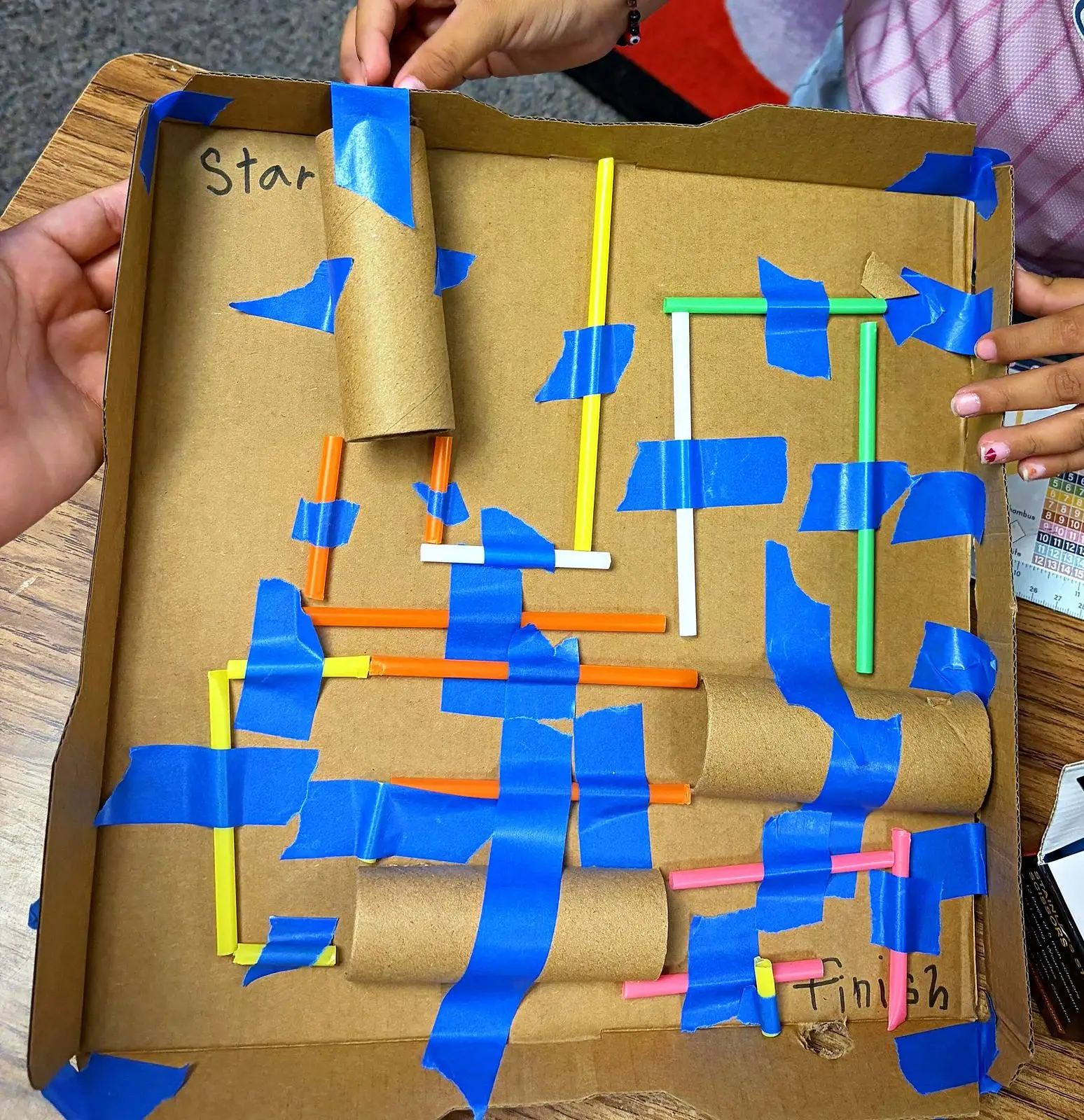
Once students have broken down the problem, they move into a build phase using modular components. During this phase, instructors are not asking students whether they got the right answer. They are asking students to notice what changed between one attempt and the next. Why did the robot veer left when you expected it to go straight? What is consistent across two builds that are failing in the same way? This is pattern recognition — the ability to identify structure within what looks like noise — and it is practiced entirely through physical observation, not through reading documentation or watching a demonstration.
This matters for parents to understand because pattern recognition is one of the weakest areas for students who struggle with standardized math assessments. The National Council of Teachers of Mathematics has consistently identified pattern and structure as a foundational strand of mathematical proficiency. Students who practice pattern recognition with tangible objects before they encounter it as an abstract concept in algebra show better retention of the skill. Robotics gives them a physical context for a mental habit they will need later.
Debugging as a Formal Skill
The third major phase of a Kodely robotics session is what the curriculum explicitly labels “debug and iterate.” This is where students test their builds, document what did not work, form a hypothesis about why, make one change, and test again. The one-change rule is intentional. Students are not allowed to adjust multiple variables at once because doing so makes it impossible to isolate cause and effect. That constraint is frustrating for students who want to fix everything at once. It is also exactly the kind of disciplined thinking that separates students who are strong in science lab work from students who struggle with controlled experiments.
Debugging logic — the ability to trace an error back to its source by eliminating possibilities systematically — is not intuitive. It is taught. Most students encounter it for the first time in a formal science class in middle school, long after habits of impulsive problem-solving have already formed. After-school robotics programs for kids that embed this logic early give students a two-to-three year head start on a skill their curriculum will eventually require.
Why the Sequence Matters More Than the Robot Itself
Parents sometimes ask whether the specific robotics platform — the brand, the components, the software — makes a significant difference in outcomes. For skill development, the answer is largely no. The platform is a vehicle. What produces learning is the instructional sequence: problem framing before building, pattern observation before programming, systematic debugging before iteration. Kodely’s curriculum is designed around that sequence regardless of what hardware a school has available. The pedagogy is portable. The habits it builds are durable.
This is also why a well-run after-school robotics program looks fundamentally different from an unstructured robotics club where students free-build. Free-build time has genuine value for creativity and motivation. It does not reliably produce computational thinking skills. The structure — the Challenge Brief, the constrained build phase, the one-change debug rule — is what converts engagement into transferable cognition.
What Parents Should Ask About Any Robotics Program
If you are evaluating after-school robotics programs for kids, the quality of the experience is not visible in the robot. It is visible in the curriculum structure. Here are the questions worth asking any program provider:
- Is there a problem-framing phase before students begin building or programming?
- Do instructors ask students to explain their reasoning, not just their results?
- Is debugging treated as a discrete, structured step — or just what happens when something breaks?
- Does the curriculum progress in complexity across sessions, or does each session reset to the same level?
- Can the program staff connect specific activities to specific academic skills?
A program that can answer those questions with specific examples is a program that understands what it is actually teaching. One that leads with the brand of robot or the number of sensors on a kit is selling hardware, not instruction.
The Bigger Picture for Title I Schools
Kodely works primarily with Title I schools, and the stakes of this distinction are not abstract in those communities. Students in high-need schools are statistically less likely to encounter structured computational thinking instruction during the school day. When enrichment programs fill that gap, they do more than provide an interesting activity — they build academic infrastructure that students in better-resourced districts often receive through in-school STEM tracks, coding electives, or gifted programs. After-school robotics programs for kids done well are an equity intervention. They are giving students access to the cognitive scaffolding that shapes long-term math and science performance, and they are doing it in a context where students are choosing to be there, which is not a small thing.
The robot is a great hook. What your child is actually learning is how to think about hard problems before they panic, how to find structure in what looks random, and how to fix what is broken without guessing. Those are the skills worth talking about at the dinner table.