The conversation about after-school sports programs and kindergarten readiness rarely gets the attention it deserves. Most enrichment research focuses on third grade and up, leaving a gap in the evidence base exactly where principals and parents need it most: the five- and six-year-old window when children are navigating one of the most demanding developmental transitions of their lives. What we know from developmental science, however, is that structured multi-sport play during the K–1 period does something that worksheets and circle-time routines cannot replicate at the same intensity. It builds the self-regulation architecture that teachers use to determine whether a child is ready — socially, cognitively, and behaviorally — to thrive in first grade.
Why Self-Regulation, Not Academics, Predicts First-Grade Success
Kindergarten teachers consistently rank self-regulation skills above academic knowledge when assessing first-grade readiness. A widely cited study published in the Early Childhood Research Quarterly surveyed more than 3,500 kindergarten teachers across the United States and found that the ability to follow directions, take turns, manage frustration, and stay on task mattered far more to teachers than letter recognition or number sense when predicting which students would struggle in first grade.
Self-regulation is not a single skill. Researchers typically break it into three measurable components: inhibitory control (the ability to stop an impulse), working memory (holding and using information in the short term), and cognitive flexibility (shifting attention from one task to another). These are the executive function skills that govern behavior in a classroom. A child who cannot wait for a turn, who dissolves when a game does not go their way, or who cannot transition from recess to reading without a meltdown is going to have a difficult first-grade year regardless of how many letters they can name.
The question principals and parents should be asking is: what structured activities during the after-school hours actively train these skills in five- and six-year-olds? The answer, supported by a growing body of research, includes organized multi-sport programs.
What the Research Says About Movement and Executive Function in Young Children
The link between physical activity and executive function development in early childhood is not speculative. A 2014 meta-analysis published in Psychological Bulletin analyzed 37 studies involving children ages four through ten and found that acute bouts of aerobic exercise consistently improved inhibitory control — the single most predictive executive function marker for academic success in early elementary school. More importantly for the after-school context, the effect was strongest when the physical activity was structured and rule-governed rather than free play.
This distinction matters. Unstructured recess gives children movement and social interaction, but it does not systematically challenge inhibitory control the way a sport with defined rules does. When a kindergartener is playing a modified version of soccer and has to resist the impulse to use their hands, wait for a pass, and re-enter the game calmly after scoring a point for the other team by accident, they are doing repetitive inhibitory control training. They are doing it dozens of times across a single session, in emotionally charged situations, with real social stakes.
A study from the University of Illinois at Urbana-Champaign found that children who participated in structured physical activity programs showed measurably greater hippocampal volume — a brain region associated with working memory and learning — compared to less active peers. These differences appeared in children as young as five. This is not a marginal effect. It is a structural neurological argument for prioritizing structured movement in early childhood enrichment programming.
Why Multi-Sport Formats Specifically Outperform Single-Sport Programs for This Age Group
Single-sport specialization before age eight carries documented risks, including overuse injury, burnout, and narrowed motor skill development. But there is also a self-regulation argument for why kindergarteners benefit more from multi-sport formats than from repeating the same game week after week.
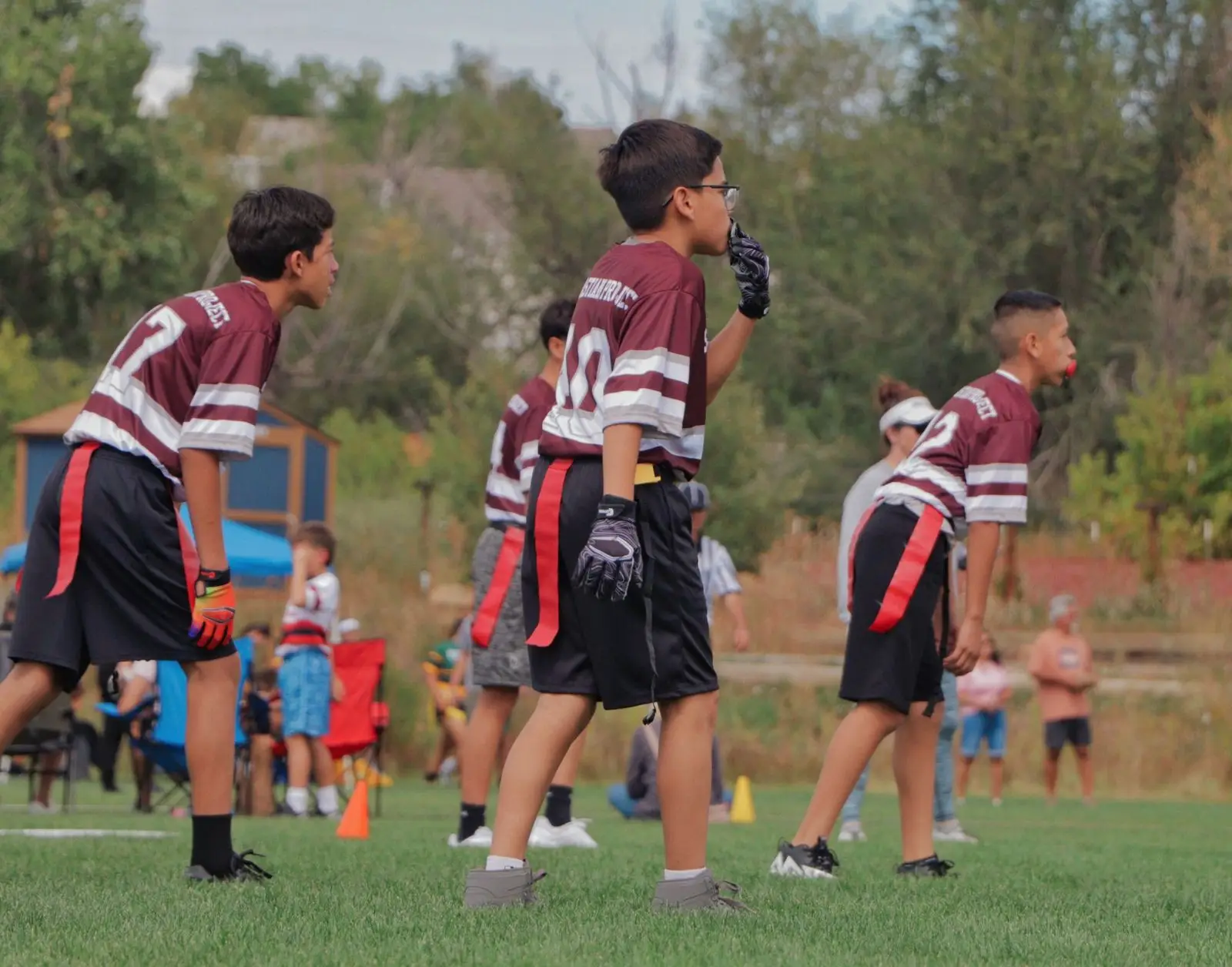
Cognitive flexibility — the ability to shift mental frameworks — is one of the three core components of self-regulation. Multi-sport programs train it directly. When a child spends one week learning the rules of flag football and the next week navigating the entirely different spatial logic of volleyball, they are practicing cognitive flexibility in a motor context. The rules change. The equipment changes. The social dynamics within the team shift. Every transition between sports is a low-stakes cognitive flexibility exercise that transfers directly to the classroom skill of adapting to a new subject or a new teacher expectation.
Research from the American Development Model, published by U.S. Soccer and subsequently adopted by several national governing bodies, recommends multi-sport participation through at least age twelve, with the strongest developmental arguments concentrated in the five-to-eight window. The rationale is partly about injury prevention but equally about broad motor skill acquisition — the kind of foundational physical literacy that supports coordination, spatial reasoning, and body awareness in ways that support classroom learning.
Kodely’s after-school sports programs are built on this multi-sport model. At Title I schools where children often have limited access to organized recreational leagues outside of school, the after-school slot may be the only structured sports exposure a kindergartener receives. That context makes program design decisions consequential in ways they might not be in more resource-rich settings.
Giving Principals a Talking Point With Skeptical Parents
One of the most common objections principals hear when families see a sports enrichment slot on the after-school menu is a version of: “My child needs academic help, not more running around.” This objection is understandable. Parents in high-need communities are often acutely aware of academic gaps and anxious about any activity that does not look like direct instruction.
The talking point principals need is direct: the research does not support separating physical enrichment from academic preparation at this age. They are not competing priorities. Inhibitory control — the ability to stop, wait, and think before acting — is both the primary outcome of structured sport participation in five- and six-year-olds and the primary behavioral marker first-grade teachers use to identify children who will need early intervention support.
A child who can regulate frustration on a playing field is far more likely to persist through a difficult reading task in January of first grade. A child who has practiced turn-taking in a structured game setting every week for eight months is more prepared for the social-emotional demands of a first-grade classroom than a child who spent those hours in passive enrichment or screen time. These are not soft claims. They are supported by the same developmental science that informs early childhood curriculum standards.
Specific Outcomes to Share With Parents
- Structured sport participation in kindergarten is associated with measurable improvements in inhibitory control by the end of the school year
- Children in organized physical activity programs show better frustration tolerance on standardized behavioral assessments than matched peers in non-active programs
- Turn-taking proficiency, assessed through teacher observation tools, improves significantly in children with consistent exposure to rule-governed group games
- Multi-sport formats produce broader gains in cognitive flexibility than single-sport programs for children under age eight
What Schools Should Look for in a K–1 Sports Enrichment Program
Not every sports program is structured to deliver these outcomes. The developmental research is specific about the conditions that produce self-regulation gains: activities must be rule-governed, emotionally engaging, socially collaborative, and progressively challenging. Programs that prioritize free play over structured games, or that do not build in explicit opportunities for turn-taking and frustration recovery, will not reliably produce the executive function benefits the research describes.
When evaluating after-school sports programs for kindergarten readiness, administrators should ask whether instructors are trained in early childhood development, whether the curriculum sequences multi-sport exposure intentionally, and whether session structures include explicit coaching around self-regulation moments — the pause after a disputed call, the rotation that requires a child to sit out temporarily, the cooperative game that requires negotiation rather than individual performance.
Kodely designs its sports programming with these developmental benchmarks in mind. In Title I schools, where after-school enrichment may represent the most consistent access to structured physical activity a child has outside of the school day, program quality is not a secondary concern. It is the entire argument for the investment.