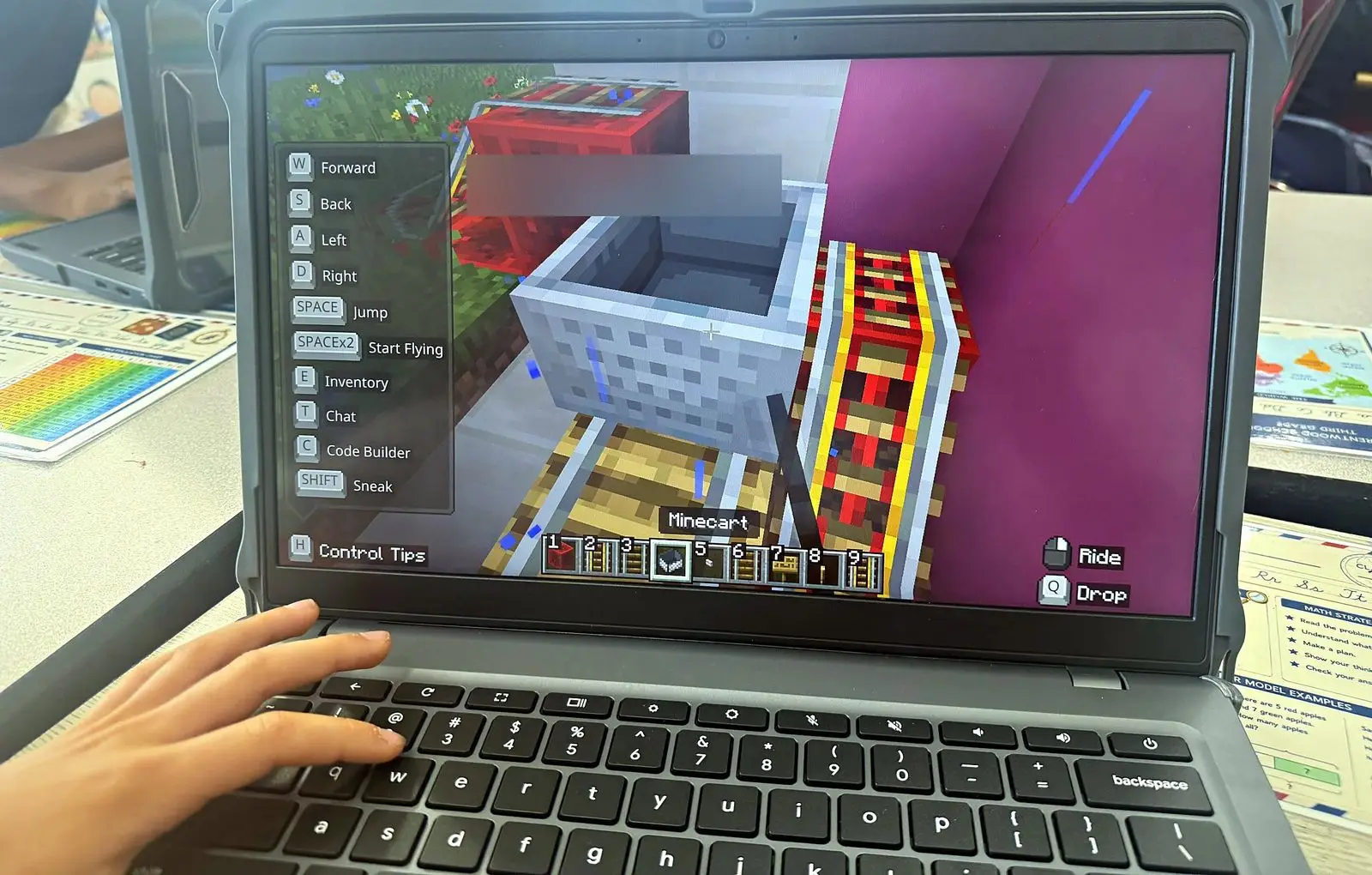
Every semester, parents make the same calculation: their child’s school just added a computer science elective, so the after-school coding program for kids they’ve been paying for must now be redundant. It’s a reasonable assumption on the surface. Both involve screens, both involve code, both get mentioned on college applications. But the assumption is wrong, and it costs kids something real. School-day CS classes and after-school coding programs are built differently, paced differently, and develop different skills — understanding that distinction changes how you think about your child’s education in tech.
What a School-Day CS Class Is Actually Designed to Do
Public school computer science classes operate within the same structural constraints as every other subject on the schedule. Teachers work from a pacing guide. The curriculum has to align with state standards. There are standardized assessments, grade-level benchmarks, and a finite number of class periods per week — usually three to five, each running 45 to 55 minutes.
In that model, the primary goal is coverage. A typical middle school CS course needs to introduce computational thinking, basic algorithms, data representation, and digital citizenship — all within one academic year, for a classroom of 25 to 35 students with wildly different prior exposure to technology. The teacher’s job is to bring every student to a minimum competency threshold. That is an important and legitimate function. It is not the same function as depth.
The College Board’s AP Computer Science Principles course, one of the more rigorous school-day options available, has seen significant growth since its launch — with over 170,000 students taking the AP exam in 2023. But even AP CSP is a broad survey course. It covers programming concepts, data analysis, the internet, and cybersecurity impacts. Students build a single performance task across the year. The breadth is valuable. The depth of any one area is limited by design.
What After-School Coding Programs for Kids Are Actually Built For
After-school coding programs operate with a fundamentally different mandate. There are no state standards to satisfy, no report cards to generate, no 35-student classroom to manage toward uniform outcomes. That freedom is structural, and it shapes everything about how learning happens.
In a well-run after-school coding program, a student can spend six consecutive weeks building a single game in Scratch, then spend the next session pulling the whole thing apart to rebuild the scoring system from scratch because they had a better idea. That kind of iterative, student-directed work is nearly impossible to accommodate in a 50-minute class with a pacing guide. After-school programs are built for it.
The focus is also narrower by design. Rather than introducing every major area of computer science, after-school programs typically go deep on one thing at a time — game design, web development, robotics and hardware, app prototyping, Python fundamentals. A student who spends a semester in a Kodely coding program isn’t surveying the field. They’re building something, breaking it, fixing it, and building something better. That repetition of the build-fail-iterate cycle is where genuine skill development happens.
The Role of Low-Stakes Failure
One of the most underappreciated differences between school-day and after-school environments is what failure costs. In a CS class, a broken program that doesn’t run by Friday affects a grade. That grade goes on a transcript. That transcript matters for high school placement, scholarship applications, and college admissions. The stakes are real, and they create real risk aversion.
After-school programs carry none of that weight. When a student’s robot doesn’t navigate the obstacle course correctly, the consequence is: try again. Research consistently shows that low-stakes environments accelerate skill acquisition in coding specifically because learners are more willing to experiment. A 2020 study published in the Journal of Educational Computing Research found that students in project-based, non-graded coding environments demonstrated significantly higher rates of creative problem-solving than peers in traditional graded CS settings. The absence of a grade isn’t a feature gap — it’s a design advantage.
The Depth and Pacing Problem No One Talks About
Even the best school-day CS teachers are working against the clock in ways that after-school instructors are not. Consider what happens when a student gets genuinely curious about something mid-lesson. In a school class, that curiosity has to wait. There’s a next topic to introduce, a quiz to prep for, a unit that has to wrap up before spring break.
After-school programs can follow the curiosity. If a group of fourth graders suddenly wants to understand why their animation loop isn’t running at the right speed, a Kodely instructor can spend the next 20 minutes going deep on timing functions and frame rates because there’s no bell schedule punishing that detour. Curiosity-driven learning in coding is not a soft benefit — it is how students move from executing instructions to actually understanding systems.
Pacing is also personalized in ways that classroom settings structurally cannot be. A student who picks up conditionals quickly doesn’t have to wait three class periods for the rest of the cohort to catch up. A student who needs more time with loops gets it without falling behind on a class-wide timeline. That responsiveness is only possible when you’re not accountable to a grade-level standard that every student has to hit by the same date.
Project Ownership Changes Everything
There’s a meaningful difference between a project that fulfills an assignment and a project that belongs to a student. In school-day CS classes, projects are typically scoped by the curriculum: build this specific type of program, using these specific tools, and submit it by this date. That’s appropriate for a graded course. But it produces a specific kind of relationship between the student and the work — compliance-oriented rather than ownership-oriented.
In after-school coding programs, students frequently choose what they’re building and why. A Kodely student who decides to build a quiz game about their favorite athlete, then adds a leaderboard, then teaches a younger sibling how to play it, has developed a relationship with that project that no graded assignment replicates. That ownership is what builds the intrinsic motivation to keep learning after the program ends.
Why Both Matter — and Why Pulling Kids From Enrichment Is a Mistake
The question parents should be asking isn’t “which one covers coding?” It’s “what is each one actually building in my child?” School-day CS classes build foundational literacy, expose students to the breadth of the field, and — in rigorous courses — provide academic credentials that matter. Those are real things worth having.
After-school coding programs build depth, build creative confidence, build the kind of iterative problem-solving that professional developers actually use, and do it in an environment where failure is safe and curiosity is rewarded. Research from the Afterschool Alliance has consistently shown that students in structured after-school STEM programs are more likely to pursue STEM careers — not because after-school programs are better than school, but because they reach students differently.
The two don’t overlap. They compound. A student who gets CS literacy from school and project-based depth from after-school enrichment is better positioned than a student who has only one of those things. Pulling a child from an after-school coding program because their school added a CS elective isn’t doubling up — it’s trading one thing for a different, not interchangeable, thing.
Kodely works with over 500 schools, the majority of which serve Title I communities where access to enrichment has historically been limited. What we see consistently is that students who participate in both school-day CS and after-school coding programs don’t experience redundancy — they experience reinforcement, applied in different contexts, building different capacities. That combination is what actually prepares kids for a world that runs on code.