There are two very different things that call themselves after-school arts programs.
One is a structured, developmental experience where students learn to look carefully, make deliberate choices, express something they actually mean, and build a body of work they’re proud of over time. The other is supervised free time with construction paper.
Both are common. Only one produces the outcomes — confidence, creative thinking, emotional expression, and identity development — that make arts enrichment worth prioritizing in your school’s programming. Here’s how to tell them apart, and what to look for when evaluating arts enrichment for your students.
What Arts Enrichment Actually Develops
The research on arts education consistently identifies a cluster of outcomes that go well beyond artistic skill:
- Creative risk-taking: Students who learn to make artistic choices in a low-stakes environment develop a tolerance for uncertainty and experimentation that transfers to academic problem-solving
- Sustained attention: Completing a drawing, a painting, or a collage requires the kind of focused, deliberate attention that is increasingly rare and increasingly valuable
- Self-expression and emotional processing: For many students — especially those who struggle with verbal expression — visual art and music provide a channel for processing difficult emotions safely
- Critical observation: Learning to look carefully at a painting, a sculpture, or a piece of music trains the habit of paying attention to detail that is foundational to scientific thinking, reading comprehension, and problem-solving
- Revision and persistence: Art that goes through multiple drafts teaches students that quality comes from iteration, not from getting it right the first time
Visual Arts: What Good Programming Looks Like
A high-quality after-school visual arts program has a few defining characteristics:
Students make things they chose
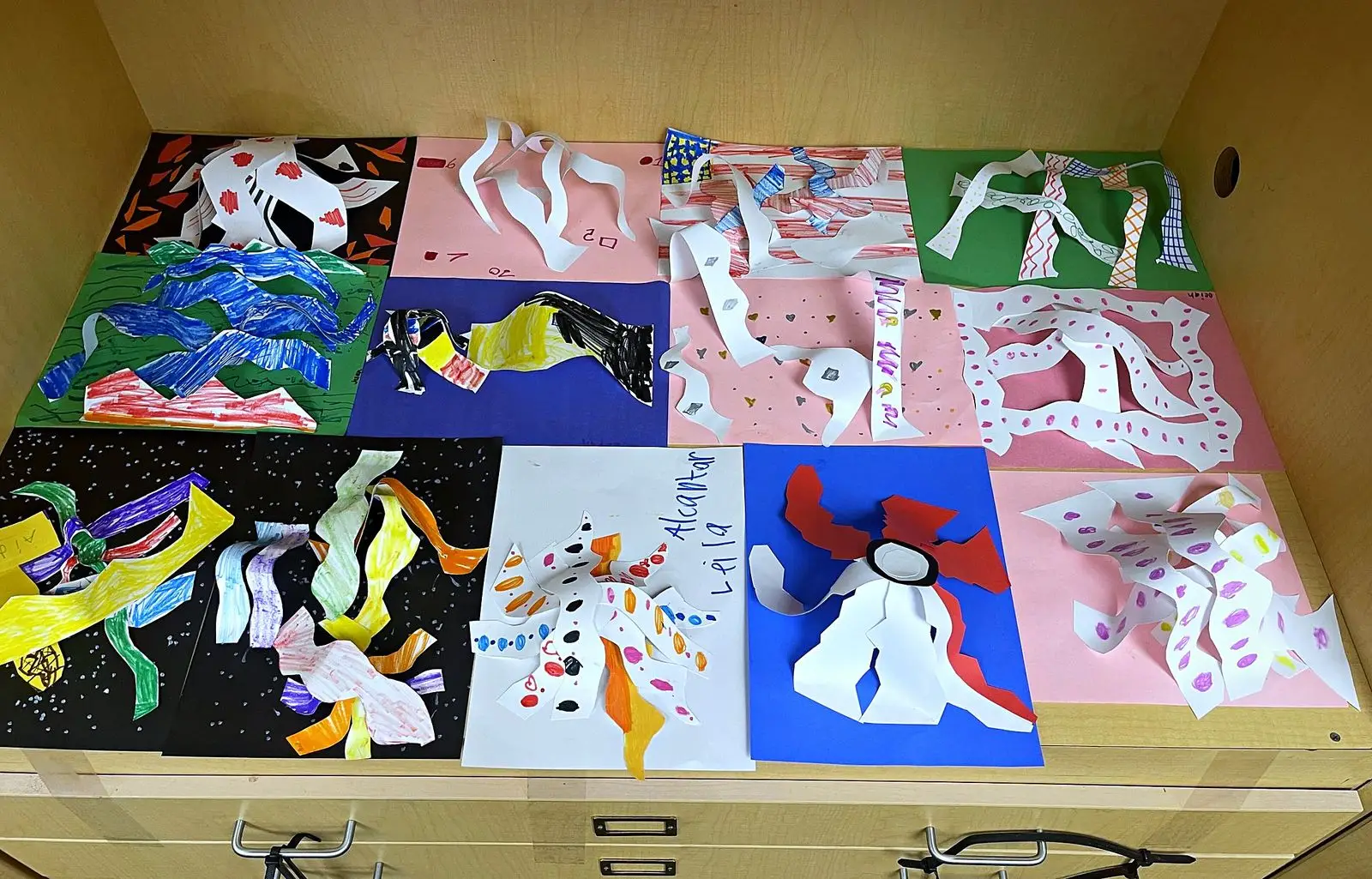
In weak programs, every student makes the same thing — the same paper plate mask, the same traced hand turkey. In strong programs, students are given a concept, a technique, or a constraint and then make something that is genuinely theirs. The instructor’s role is to teach skills and ask questions, not to ensure uniformity.
There’s a real skill progression
Students should be learning something over time. Week one doesn’t look like week twelve. Instructors introduce techniques, build vocabulary, and expand what students can do — not just give them time to “be creative” with no instruction.
Students talk about their work
A defining feature of quality arts programs is the practice of artist talk — students explaining what they made, what choices they made, and what they were trying to express. This habit of articulating creative intention builds language skills, self-awareness, and the ability to give and receive feedback.
Finished work is displayed and celebrated
Students in arts programs should have their work treated as worthy of display. A wall of student work, a school showcase, a digital portfolio — these practices communicate that what students make matters. That communication is itself a developmental intervention.
Music: What Good Programming Looks Like
After-school music programs range from passive listening sessions to structured ensemble instruction. The programs with the strongest outcomes share common elements:
- Students play, not just listen: Even in programs that don’t have instruments for everyone, students are making music — clapping, singing, beatboxing, using body percussion — not passively observing
- There’s a performance component: Working toward a performance creates real stakes, real motivation, and a real sense of accomplishment that passive participation cannot produce
- Instructors connect music to something students already care about: Programs that build from music students know — hip-hop, pop, regional music — before expanding outward have far higher engagement than programs that start with classical theory and work down
Theater and Drama: What Good Programming Looks Like
Theater is one of the most powerful after-school enrichment formats for social-emotional development, and one of the most underused. Strong theater programs:
- Use improv and ensemble exercises before moving to scripted performance — these build trust, listening, and physical self-awareness
- Create space for students to write and perform their own material, not just execute someone else’s script
- Have a culminating performance for a real audience — parents, the school community, or the broader neighborhood. The act of performing changes students’ relationship with public speaking and self-presentation permanently.
Questions to Ask When Evaluating an Arts Program
For school leaders and parents considering an arts enrichment program, these questions surface the quality signals quickly:
- “Can I see what students made last semester?” (The quality and variety of work tells you everything)
- “What does a student learn how to do between week one and week twelve?” (Tests whether there’s real skill progression)
- “Do students choose what they make, or does everyone make the same thing?” (The single biggest quality differentiator)
- “Is there a performance, showcase, or exhibition at the end of the year?” (Reveals whether the program has real stakes)
- “How are your instructors trained in arts instruction specifically?” (Arts programs need instructors who are artists and educators, not just supervisors)
What Arts Enrichment Isn’t
Arts enrichment is not free time. It’s not a reward for finishing homework. It’s not craft supplies set out on a table with an adult present to keep the peace.
Those things are fine for what they are — they give students a place to be, and that matters. But they don’t produce the developmental outcomes that justify prioritizing arts in your enrichment budget. The difference between structured arts instruction and unstructured arts time is the difference between a student who leaves with a new way of seeing the world and a student who made a macaroni picture.
When arts programs are designed with intention — with real instruction, real skill development, real choice, and real stakes — they are among the highest-impact forms of after-school enrichment available. Students who would never raise their hand in a math class will stand up in front of their whole school and perform something they created. That transformation is worth building a program around.
Frequently Asked Questions
What should a good after-school art program include?
A strong after-school arts program should include structured skill-building, opportunities for students to make deliberate creative choices, and enough continuity for students to develop a body of work over time. Look for programs where students are guided to observe carefully, reflect on their decisions, and express ideas that are personally meaningful rather than simply completing one-off crafts.
How is a real arts program different from arts and crafts activities?
A real arts program builds skills progressively and asks students to make intentional choices about what they want to communicate through their work. Arts and crafts activities tend to follow a template where every student produces the same result, which builds little creative or technical capacity over time.
What age is appropriate for after-school art classes?
After-school art programs can be developmentally appropriate for students as young as kindergarten, provided the instruction is matched to the child’s stage of development and motor skills. The most important factor is not age but whether the program challenges students to think and grow rather than just keep them occupied.
How do I evaluate the quality of an after-school arts program?
Ask to see student work from earlier and later in the program year to assess whether real growth and development are visible over time. Also ask whether students can talk about why they made specific choices in their work, which is a reliable sign that the program is teaching genuine artistic thinking rather than just production.
What are the benefits of a structured after-school arts program for kids?
A structured arts program builds skills in focused observation, creative problem-solving, and self-expression that transfer across academic and personal areas of life. Students who develop a body of work they are genuinely proud of also gain a meaningful sense of competence and identity that goes well beyond the art itself.